

 Tweet
Tweet
I still have my original Amiga 1000 and 500 [with the A500 HDD] and I am not going to head out to the farm and dig through the barn but I have a Sperry UNIVAC 1616 Snap II ballistics computer off a submarine. We originally picked it up to play a prank but never got around to doing it. I am willing to give the Sperry away to anybody who wants to come pick it up in the spring =) We also have a Wang Archiver, but I haven't seen it in about 10 years ...
-
EVE Online: 99% of the time you sit around waiting for something to happen, but that 1% of action is what hooks people like crack, you don't get interviewed by the BBC for a WoW raid. -
Isn't that what the Plastercasters used?Quoth AccountingDrone View Post I am not an a**hole. I am a hemorrhoid. I irritate a**holes!
Procrastination: Forward planning to insure there is something to do tomorrow.
Derails threads faster than a pocket nuke.Comment
-
I had two of those - a portable XT with pure monochrome, and a Compaq Portable AT, circa 1985 or 1986, with the 'shades of green' display. A friend donated a 40-mb SCSI hard drive (which he claimed I'd 'never fill'!) and controller to this rig, and with it I ran a bulletin board service for roughly 3-1/2 years in the late 1980s and early 1990s.Quoth Nunavut Pants View Post
It's remarkable, really, to think that back when they were new, those ranked among the most sophisticated 'consumer-level' machines on the planet, and now they wouldn't even be realistically considered for use as a lowly POS terminal.
I seem to recall a statement about the 286 processor (which powered my AT)...
"It's really a server. Nobody will ever require a machine this powerful."Comment
-
Wow, that's pretty cool! Never heard of that before; must've been quite ahead of its time. The closest thing I'm aware of is the "QuantumLink" (aka Q-Link) online service which Commodore 64/128 users could connect to back in the '80s and early '90s. Eventually, they dropped the C=64 version, and changed their name to America Online.Quoth Nunavut Pants View Post
The Amiga stuff is really cool, and was rather ahead of its time with regards to multimedia. Amigas of various types were used for video and audio production for many years; I used an Amiga 1200 in high school to generate on-screen graphics for the school news broadcasts. I have an Amiga 1000 and an Amiga 2000, both of which are equipped with numerous upgrades (the 2000 even has a genlock).Quoth AccountingDrone View Post
Yeah, that's a common thread with regards to computer technology. I remember the first time I came across a 1 gigabyte hard drive in the early '90s; I had no idea that that much data could be stored in one place. Before that, our home computer had managed to get things done using 5.25" floppy disks holding 180KB or so apiece. Of course, it seems that as technology advances and storage space increases, software seems to expand to fill said new resources and space.....Quoth CyberLurch View Post
-AdamComment
-
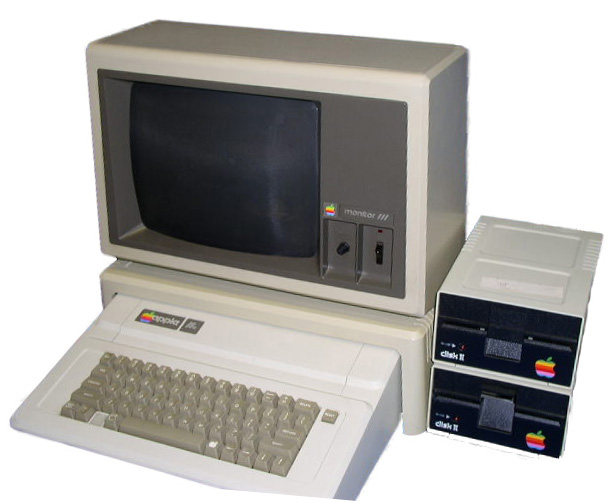
My father took one of these home in 1983, and I used it for ten years. I used to have quite a collection of old 1980s computers - there was a Mac Plus and a Commodore 16 and an IBM 8086 and a TRS-80, and for a while my only laptop was a Zenith 286 lunchbox model. I got rid of most of the collection a couple of moves ago (the Apple IIe fetched a sweet price on eBay).
I've always lagged about five years behind the latest and greatest (I "upgraded" from an Apple IIe to a six-year-old IBM 80286 in 1993) which meant that I didn't pay much for my equipment, but didn't have the best software, either.Comment
-
Very nice! When I was a kid, my family lagged a good deal behind the curve when it came to computers for some reason. We didn't have a computer of any sort until 1992, when a relative handed us down an Apple IIe and Apple II+. It was the first computer I'd ever seen, but I quickly learned the ways of 5.25" floppy disks, dot-matrix printers, and BASIC programming. One of the disks it came with was Bank Street Writer, which came in handy when I entered the fourth grade (later that same year), and discovered that they were using Bank Street Writer III. I soon learned the ins and outs of word processing, and used the Apple IIe and BSW to do my typed homework for many years. In 1997, the same relative handed us down a 486DX-33 box at the same time he was upgrading to a Pentium computer (I suspect it's the computer he'd upgraded to when he handed us down the Apple II stuff). A few years after that, we bought ourselves our first brand new computer, a Compaq Pentium II machine.Quoth Ben_Who View Post
It's a shame you got rid of those classics; hopefully, they all ended up in deserving homes. I still have the Apple IIe and II+ (though they've been upgraded a bit since then), plus all of the computers seen on my above-linked site (and a few others I haven't bothered to list). I'm hoping to start a vintage tech museum at some point in the future so that people can experience this obsolete stuff for themselves.
I've stayed behind the curve for some time now, mainly because I see no real reason to buy brand new hardware at this time (the last time I bought a brand new computer was in 2006). For the past 10 years or so, I've been making use of used Macs purchased at flea markets and swapmeets (mostly PowerMac G4s). My main computer at this point is a MacBook Pro from 2008, with my auxiliary computer being a PowerMac G5 from 2005. Unfortunately, the old PPC Macs are being left in the dust by internet technology, so I'll soon be upgrading from the G5 to an early Mac Pro which I bought last year. It's such a chore living on the trailing edge.....
-AdamLast edited by AdamAnt316; 02-24-2016, 01:26 AM.Comment
-
We had an Apple III too! My dad had his own advertising agency in the 1980s, and had picked one up to (hopefully) replace the slow-as-balls Xerox computers (remember those things?) he used, which ran CP/M off 8-inch floppies. Even by 1980, those Xerox machines were expensive (they cost about six grand--more than a new car at the time and really weren't suited to things other than word processing and keeping track of data.
While the III's graphics weren't quite "state of the art" they were miles ahead of the crude ASCII display on the Xerox machines. You could actually play games, watch horses run across the screen, etc. The thing I didn't like about the III (which wasn't a Plus model), is that it didn't always like to run Apple II programs, including anything I'd done in Basic. Plus, the damn thing would occasionally overheat and shut down.
By 1990, the III was pretty much dead. Limited software, no parts availability, and the rise of IBM "clones" meant it was sold for scrap...and replaced with one of the clones, a "Swan" -branded machine, IIRC.
Those weren't the only computers at home--we had a succession of TI 99-4/A (and the -4) machines as well. By the mid-to-late-1980s, you could get them for a few dollars at a yard sale. I think I still have them hiding in the basement somewhere...no idea if they still work.Aerodynamics are for people who can't build engines. --Enzo FerrariComment
-
Very cool! A shame you got rid of your Apple III.Quoth protege View Post I've wanted one of those for years, along with its short-lived successor, the Apple III Plus. I saw a III for sale at the MIT Swapfest this past summer, priced at $300. It was intriguing, but rather high-priced for my tastes, and I thought I might be making a trade deal for one, so I hesitated, and later found out that it'd been sold. Hopefully, I'll come across another one at some point in the future. Did you ever have to drop yours to get it to work?
The TI home computers are interesting. I've owned several TI-99/4As over the years, though I've never seen a plain TI-99/4. The story of Texas Instruments' home computers is an interesting one: back in the mid 1970s, TI made chips for calculators produced by other companies, such as Commodore. Eventually, TI started producing tons of their own calculators at bargain prices, undercutting their competitors, and eventually killing off the calculator market as a whole. Said companies soon moved into producing home computers, an industry which flourished for a time.
Then, in the early '80s a virtual bomb was dropped on the home computer industry, as a particular model was introduced with competitive specs, and a very reasonable price. It was...Commodore, who had licked their wounds after nearly being killed off in the calculator market crash, bought a semiconductor company, and introducing the Commodore 64 in a successful attempt to get revenge on TI by sinking their home computer business. Of course, the IBM PC eventually came to own the home market anyway, with Apple taking up much of the slack, leaving Commodore and whoever was left to pick up the pieces in the long run...
-AdamComment
-
I don't ever remember dropping it...but I do remember my dad throwing some very colorful phrases at it towards the endQuoth AdamAnt316 View Post But seriously, the III served its purpose--learning Basic, typing up book reports, making signs, that sort of thing. Had Steve Jobs (and by default, Apple) insisted on some sort of ventilation in the power supply, it might have been a success. But, it wasn't. When the III Plus came out, the machines were already tainted as junk.
Our III finally went simply because it was wearing out, and incompatible with what I was learning at school. They had PCs, and trying to do one's homework at home on an Apple...wasn't happening.Aerodynamics are for people who can't build engines. --Enzo FerrariComment
-
Yeah, Apple had a lot of issues with the III, most of them self-inflicted. They didn't attempt another computer with III in the name until the early '90s, when the LC III debuted. Fortunately, this was a reversal of the 'trend'; unlike the LC and LC II which preceded it, the LC III wasn't crippled with a compromised design.Quoth protege View Post
Yeah, I'm sure your III was far from alone in suffering that fate (I bet most of 'em got dumped quite a bit earlier). I'm hoping to find one at some point which has managed to survive the years, but we shall see. As for homework, I managed to put a series of Commodore machines to good use in high school in the late '90s/early '00s. First a Commodore 64, then a Commodore 128, and finally a Commodore 128D.
I was helped along by a friend whose family got rid of a whole bunch of Commodore stuff, including GEOS software, and a 512KB "RAM Expansion Unit" (able to act as a virtual disk drive within GEOS, which sped things up dramatically). Printouts were done using a Commodore dot-matrix printer (wouldn't be surprised if I was the last kid in school handing in dot-matrix printouts). Eventually, I "upgraded" to a surplus Macintosh SE, but the 'ancient' Commodore hardware worked exceedingly well for everything I threw at it.
-AdamComment
-
I'd be surprised if there were any IIIs left. There weren't all that many made (around 60,000--far fewer than the 2 million IIs sold by 1984Quoth AdamAnt316 View Post). When we had ours, parts were hard to find even then. The III was such a "specialist" model, that very few of the computer shops (think mom and pop-type stores, no Best Buy or Circuit City back then) locally even carried them or could service them.
What was odd about the III, is that when it did finally go...I was given an old CP/M machine to play with. That would have been 1993-94, when it was about 20 years old. Slow as hell, used 8-inch floppies, and took up most of my desk, but was fine for typing up papers. I had that about a year before it finally broke, and I got a "real" computer
Aerodynamics are for people who can't build engines. --Enzo FerrariComment
-
There are probably at least a few out there. Sun Remarketing was selling refurbished IIIs into the early '90s, at the least. The fact that I was able to find an Apple Lisa was also due to their refurbishing of failed Apple products. If only they were still around so I could get some replacement parts for the thing...Quoth protege View Post
CP/M is a fun OS to play around with. My Commodore 128s are able to boot into it, thanks to the Z-80 CPU included in the design. I also have a Kaypro 2X, which was a late entrant into their luggable line. Wouldn't mind finding an Osborne 1 at some point...
-AdamComment
-
I had CP/M on my Apple][+ with a Z-80 plugin card. CP/M was a LOT like Unix and a GOOD dose of IBM PC-DOS 1.1/MS-DOS 1.1 thrown in.Quoth AdamAnt316 View PostI'm lost without a paddle and headed up SH*T creek.
-- Life Sucks Then You Die.
"I'll believe corp. are people when Texas executes one."Comment
-
Ironically enough, one of Microsoft's very first hardware products was the SoftCard, allowing the Apple ][+ to run CP/M. DOS itself was "borrowed" from a clone of CP/M called QDOS, otherwise known as 86-DOS. Microsoft told IBM that it had an operating system for its new Personal Computer, when in fact they had nothing. They first talked to Digital Research in an attempt to license CP/M; when talks broke down, they looked elsewhere and found a little company called Seattle Computer Products, who'd come up with a CP/M-like OS to go with their 8086-based kit computers. IBM did end up also offering CP/M-86 with the PC (along with a Pascal-based OS), but Microsoft's "borrowed" OS soon became the defacto standard on it.Quoth Racket_Man View Post
-AdamComment
-
YUP the Softcard was the card I had installed in my Apple][+ to rum CP/MQuoth AdamAnt316 View Post
Yeah the story of M(ess)S-DOS is one for the ages and these days no one really knows the story anymore. They just assume that MS did indeed create IBM PC-DOSI'm lost without a paddle and headed up SH*T creek.
-- Life Sucks Then You Die.
"I'll believe corp. are people when Texas executes one."Comment


Comment