Announcement

Collapse
No announcement yet.

The Vintage Computer Appreciation Thread

Collapse
This topic is closed.
X
X
 
  • Filter
  • Time
  • Show
Clear All
new posts

  • #46
    Thanks for the articles, Adam!

    I found out that there isn't a lockout chip per se on the TI 99/4A; it's a different BIOS. TI wanted to discourage 3rd party software, so they updated their BIOS to lock out 3rd party software. If your TI 99/4A is running version 2.2, date of 1983, then it has the updated BIOS, like here.

    People found out how to get around this - the computer just had to be reset while the cart was plugged into the computer. Users modded their computers to have a reset button, adapters were made to plug between the cartridge slot and the cartridge, and software manufacturers made reset buttons on the carts. Ironically, lack of 3rd party support was one of the issues that killed it...

    I have 2 3rd party carts, one that doesn't have the reset and I can't use, and one that does. Instead of messing with my computer, I'll be searching for an original 99/4A.

    Reminds me - I did have a couple of Atari computers, an 800 and a 1200XL. I traded them for some Sega Genesis stuff.

    Comment


    • #47
      Quoth Shangri-laschild View Post
      I may just end up pulling everything in the case and putting something different inside. I'd feel bad about that if it were a more rare one but I'm pretty sure the one I have isn't all that rare and right now I'm doing what most online seem to be doing with it which is putting my monitor from another computer on it.
      Would be a shame if it were to come to this, but whatever works for you. If you were close by, I wouldn't mind at least having a look at them. As I said before, I have yet to own any SGI stuff, mainly since I'm not too knowledgeable about it.

      Quoth RichS View Post
      Thanks for the articles, Adam!

      I found out that there isn't a lockout chip per se on the TI 99/4A; it's a different BIOS. TI wanted to discourage 3rd party software, so they updated their BIOS to lock out 3rd party software. If your TI 99/4A is running version 2.2, date of 1983, then it has the updated BIOS, like here.

      People found out how to get around this - the computer just had to be reset while the cart was plugged into the computer. Users modded their computers to have a reset button, adapters were made to plug between the cartridge slot and the cartridge, and software manufacturers made reset buttons on the carts. Ironically, lack of 3rd party support was one of the issues that killed it...

      I have 2 3rd party carts, one that doesn't have the reset and I can't use, and one that does. Instead of messing with my computer, I'll be searching for an original 99/4A.

      Reminds me - I did have a couple of Atari computers, an 800 and a 1200XL. I traded them for some Sega Genesis stuff.
      Wasn't aware of the BIOS differences. I'll have to dig my 4As up at some point, and see what they yield. I think I've had at least four of the things; one of them was a silver model which I stuffed the electronics of a beige model into, mainly because a) the mainboard in the silver one was dead, and b) I wasn't crazy about the looks of the beige one. Ended up giving it to a friend at some point.

      Interesting on the third-party stuff. Pretty sure all of the TI carts I've had were first-party titles, including a few meant to work with the Speech Synthesizer (which I have an example of). Speaking of TI, I had no idea their computer lineup continued past the TI-99/4A era; a friend of mine recently gave me an old TI Extensa 555 laptop from the mid '90s. No idea if it works, but it's built like a tank, and has a few accessories with it.

      Atari made some neat computers. I love the tank-ness of the original 800, and the 1200XL I got recently might have some potential. I'd really like to find some more hardware and software to go with the various 1040STs I've ended up with over the years. Had to buy a mouse for it on eBay, and little else has shown up locally for them besides the computers themselves...

      Anyway, in addition to the above-mentioned TI Extensa laptop, I've now ended up with another Macintosh Plus! I usually prefer not to acquire duplicates of stuff I already have, but this one was pretty much dropped in my lap, and has a few accessories with it, including an external hard drive of some sort, plus the original box! Should be interesting to see how well it works.
      -Adam
      Goofy music!
      Old tech junk!

      Comment


      • #48
        Quoth AdamAnt316 View Post
        ...I have yet to own any SGI stuff, mainly since I'm not too knowledgeable about it.
        Pretty standard, from what I understand. Early ones had Motorola CPUs, later ones moved to MIPS. Running their own flavor of Unix, called "Irix". The graphics hardware was their "secret sauce" for quite a while; they had the matrix-multiplication graphics transformation stuff codified in a pipeline and implemented a lot of that in hardware, so it was FAST! (For the time.) They used their own graphics library, IrisGL, which eventually spawned OpenGL.

        Some of the low-end products, like the Personal Iris and/or the Indy, ran all of the graphics in software. They were a whole lot slower.

        I had a great deal of fun pushing pixels around with those machines.
        “There are two novels that can change a bookish fourteen-year old’s life: The Lord of the Rings and Atlas Shrugged.
        One is a childish fantasy that often engenders a lifelong obsession with its unbelievable heroes, leading to an emotionally stunted, socially crippled adulthood, unable to deal with the real world.
        The other, of course, involves orcs." -- John Rogers

        Comment


        • #49
          Quoth Nunavut Pants View Post
          Pretty standard, from what I understand. Early ones had Motorola CPUs, later ones moved to MIPS. Running their own flavor of Unix, called "Irix". The graphics hardware was their "secret sauce" for quite a while; they had the matrix-multiplication graphics transformation stuff codified in a pipeline and implemented a lot of that in hardware, so it was FAST! (For the time.) They used their own graphics library, IrisGL, which eventually spawned OpenGL.

          Some of the low-end products, like the Personal Iris and/or the Indy, ran all of the graphics in software. They were a whole lot slower.

          I had a great deal of fun pushing pixels around with those machines.
          Ah yes, MIPS. I know you mentioned the N64 earlier, and they did indeed use MIPS hardware for the graphics, at the least, in that system. They even made it an in-joke/boast in Super Mario 64 by including a rabbit character named "MIPS" in one of the lower areas of Princess Peach's castle. You're supposed to chase him in order to gain a Super Star and, as the name 'implies', he's rather fast.
          -Adam
          Last edited by AdamAnt316; 03-23-2016, 02:43 AM.
          Goofy music!
          Old tech junk!

          Comment


          • #50
            This really deserves its own topic under "Check It Out" but is very on topic for this discussion. Insane and awesome. https://www.youtube.com/watch?v=v-TkQ7KZcbI

            Comment


            • #51
              In those days, the RISC/CISC debate was pretty clear-cut - if you wanted the best performance, you went RISC. In a limited transistor budget, it was a heck of a lot easier to build a RISC CPU that could achieve one instruction per cycle consistently than a CISC CPU that could do the same. Later, RISC CPUs were the first to go superscalar (more than one instruction per cycle) for the same reason.

              In some cases, the difference was quite ridiculous; it was possible at one point to get an ARM CPU with under 100K transistors to beat a 486 with 1.2 million transistors - while the ARM was running interpreted BASIC and the 486 was running hand-optimised assembly. And both ran at the same clock speed.

              ARM is now the most-used instruction set in the world. Other RISC architectures that remain popular are PowerPC and MIPS. Others, such as Alpha and SPARC, have fallen by the wayside, but of the multitude of CISC architectures, only x86 and a few microcontroller types have survived.

              But if your computers were already based on a CISC CPU, it proved difficult to move from that to a RISC CPU. A lot of software back then was written with a specific CPU architecture in mind, even in pure assembler rather than a high-level language that could be recompiled, or for an OS that could not sensibly be ported to a RISC environment. That is essentially why x86 survived - too many business computers relied on it for it to just go away without a really good reason, while Intel and AMD kept enough performance upgrades coming to make the painful migration away mostly unnecessary.

              When Apple switched from 68K to PowerPC, the new PowerMacs were often able to emulate legacy 68K programs faster than a real 68K Mac could run them. The exception was legacy programs that required an FPU; Apple's own 68K emulator didn't emulate the 68K FPU, because there was no directly equivalent data type handled by the PowerPC, and most 68K Macs had been sold without one anyway. Later, some third-party emulation software *did* provide FPU emulation support.

              These days, RISC still wins the performance war - if only because the few surviving CISC CPUs requiring high performance effectively translate CISC instructions into RISC format and execute them using a superscalar RISC-like backend. This translation process is still problematic in several ways, but it works sufficiently well for most purposes.
              Last edited by Chromatix; 03-26-2016, 11:52 PM.

              Comment


              • #52
                Quoth TheSHAD0W View Post
                This really deserves its own topic under "Check It Out" but is very on topic for this discussion. Insane and awesome. https://www.youtube.com/watch?v=v-TkQ7KZcbI
                Somewhat blasphemous (I've seen far worse), but pretty cool. They really should've re-styled the flatscreen monitor to make it match the tower...
                -Adam
                Goofy music!
                Old tech junk!

                Comment


                • #53
                  (wize from your gwabe........)

                  I'm at it again! Was looking around at an antique radio swapmeet, and what should I end up buying but an obsolete computer.......


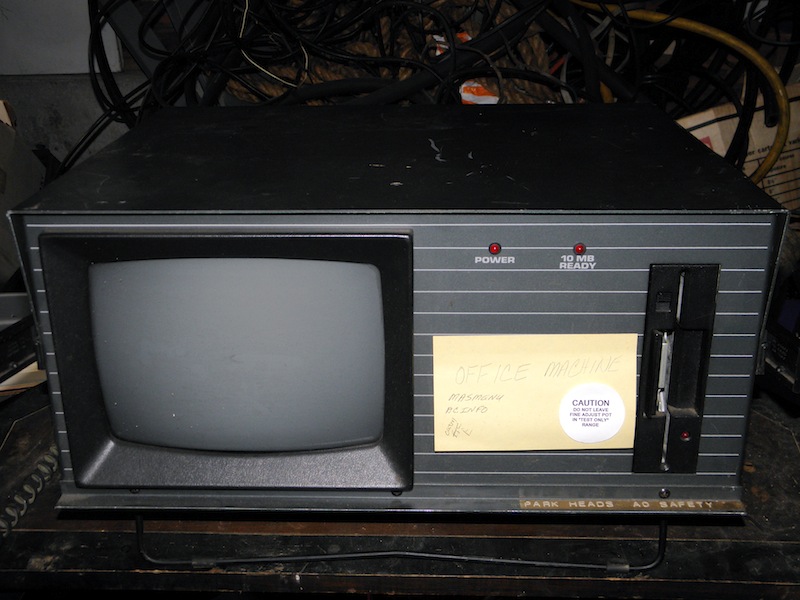
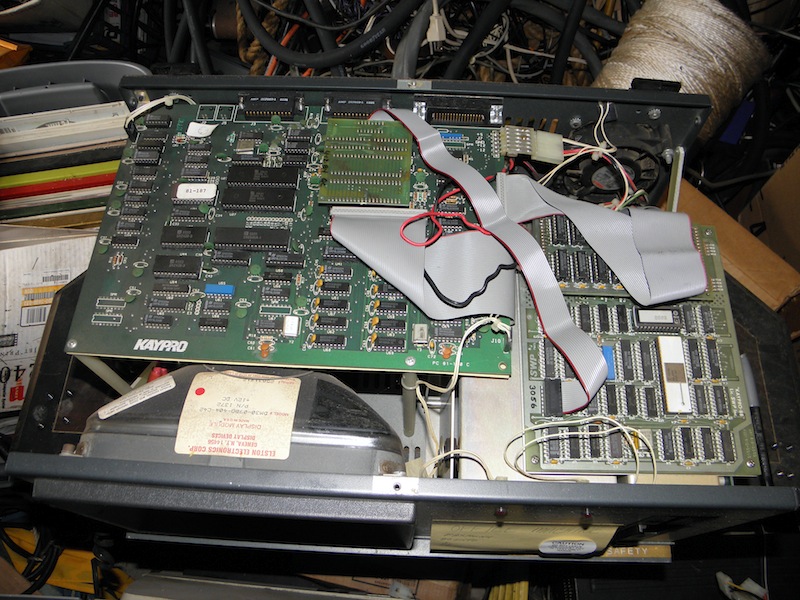
                  It's a Kaypro 10, which is basically a Kaypro II (their first and most successful product) with a 'cavernous' 10MB (not GB, or TB) hard disk drive in place of one of the floppy disk drives; apparently, it was one of the first home computers to come equipped with a hard drive as standard equipment. It runs CP/M 2.2, and the HD has a lot of productivity software installed like WordStar, SuperCalc, TurboPascal, DataStar, etc. Anyway, here's a view of the insides:


                  As acquired, the built-in hard drive was cranky, but after a few attempts at getting it to boot, it managed to spin up, and has worked without too many issues. I took the cover off of the computer, and discovered that it has an add-on board (front right corner) installed called the "SWP Co-Power 88" which allows it to run some MS-DOS programs. Some of the required files are missing, but I'm hoping that that can be rectified.
                  -Adam
                  Last edited by AdamAnt316; 05-31-2016, 11:36 PM. Reason: Now with extra added voice sample!
                  Goofy music!
                  Old tech junk!

                  Comment


                  • #54
                    Quoth AdamAnt316 View Post
                    It runs CP/M 2.2, and the HD has a lot of productivity software installed like WordStar, SuperCalc, TurboPascal, DataStar, etc.
                    Who the heck would install the multifunction display from a "Gold-dipped Freightshaker" on a vintage computer? BTW, DataStar is hardware, not software.
                    Any fool can piss on the floor. It takes a talented SC to shit on the ceiling.

                    Comment


                    • #55
                      Count me among those old enough to have served with distinction w/ the TRS-80. IBMs were the "home" team for me, Apples, the "School".

                      This brings back memories.
                      - They say nothing good happens at 2AM, they're right, I happen at 2AM.

                      Comment


                      • #56
                        Quoth wolfie View Post
                        Who the heck would install the multifunction display from a "Gold-dipped Freightshaker" on a vintage computer? BTW, DataStar is hardware, not software.
                        Not quite sure what you mean by the first part. As for DataStar, it's the name of a database program that was part of the WordStar productivity suite which Kaypro included with these machines. More info available here.

                        Quoth Argabarga View Post
                        Count me among those old enough to have served with distinction w/ the TRS-80. IBMs were the "home" team for me, Apples, the "School".

                        This brings back memories.
                        Yep, the home computer market was quite interesting in those days. Dozens (if not hundreds) of different manufacturers churning out various different computer models, and you were lucky if two of them could 'talk' to each other (even among models from the same manufacturer!). As the old saying goes, "The great thing about standards is that there are so many of them."
                        -Adam
                        Goofy music!
                        Old tech junk!

                        Comment


                        • #57
                          Quoth AdamAnt316 View Post
                          Not quite sure what you mean by the first part. As for DataStar, it's the name of a database program that was part of the WordStar productivity suite which Kaypro included with these machines.
                          DataStar is the name of the multifunction display (monochrome LCD matrix, 2 lines, can display any of a variety of functions on each line) used on Western Star trucks. Western Star is the luxury brand of Daimler Trucks (Freightliner - I used a common nickname for them - is the "mainstream" brand). Think Toyota/Lexus of the heavy truck world (hence "gold dipped" for the luxury line).
                          Any fool can piss on the floor. It takes a talented SC to shit on the ceiling.

                          Comment


                          • #58
                            Quoth wolfie View Post
                            DataStar is the name of the multifunction display (monochrome LCD matrix, 2 lines, can display any of a variety of functions on each line) used on Western Star trucks. Western Star is the luxury brand of Daimler Trucks (Freightliner - I used a common nickname for them - is the "mainstream" brand). Think Toyota/Lexus of the heavy truck world (hence "gold dipped" for the luxury line).
                            Gotcha. The display on the Kaypro is anything but multifunctional, being your average 9" green-screen CRT. The "Datastar" name has been used for a lot of things, according to Google. I'm guessing the database program was one of the first to bear it, but who knows.
                            -Adam
                            Goofy music!
                            Old tech junk!

                            Comment


                            • #59
                              I made sort of an addition during the Memorial Day holiday.

                              There's a stockyard in my hometown that has a large yard sale on Memorial and Labor Day. There is a vendor I deal with there that buys/sells old and new video game/computer equipment. That day, I saw 2 unusual cartridges I'd never seen before. They were labeled Mattel, but definitely not IntelliVision - they look like mini wheel chocks, grooved tops, with the connector on the sloped end.

                              Asked them, they said they didn't know what the went to either, and since they didn't know, they sold them to me for half-price. Went home, and researched using this book, and found that they go to the Mattel Aquarius computer!

                              I did test out my Timex Sinclair computer - it does work, but I think there might be something wrong with its membrane keyboard. I'll have to play around with it further, and find a cassette player to see if the two programs I have for it work.

                              Comment


                              • #60
                                Quoth RichS View Post
                                I made sort of an addition during the Memorial Day holiday.

                                There's a stockyard in my hometown that has a large yard sale on Memorial and Labor Day. There is a vendor I deal with there that buys/sells old and new video game/computer equipment. That day, I saw 2 unusual cartridges I'd never seen before. They were labeled Mattel, but definitely not IntelliVision - they look like mini wheel chocks, grooved tops, with the connector on the sloped end.

                                Asked them, they said they didn't know what the went to either, and since they didn't know, they sold them to me for half-price. Went home, and researched using this book, and found that they go to the Mattel Aquarius computer!

                                I did test out my Timex Sinclair computer - it does work, but I think there might be something wrong with its membrane keyboard. I'll have to play around with it further, and find a cassette player to see if the two programs I have for it work.
                                Very cool! I have a Mattel Aquarius computer (in its original box, no less), but no cartridges or anything to go with it. I've tested it, and it works in what passes for a version of BASIC on it, but that's about it. If you decide to get rid of them, please let me know (and keep an eye out for more of them there!). Games and accessories for the Aquarius seem to be fairly hard to come by, for obvious reasons.

                                What is the TS-1000 doing? If you're getting blocky-looking characters, that might be at least somewhat normal; IIRC, it defaults to those for the first character after the line number when programming in BASIC, to save on the limited memory space. Otherwise, though, I dunno. My own TS-1000 has a weird graphics issue where the screen is kinda smooshed/distorted, IIRC. I've picked up a few regular ZX-81s in the years since; really should play around with them One Of These Days™...
                                -Adam
                                Last edited by AdamAnt316; 06-06-2016, 04:14 PM.
                                Goofy music!
                                Old tech junk!

                                Comment

                                Working...
                                X